Boletim diário sobre atividade solar e geomagnética do SIDC
Publicado: 2026 May 24 1231 UTC
Previsão SIDC
Erupções solares
C-class flares expected, (probability >=50%)
Geomagnetismo
Quiet (A<20 and K<4)
Prótons solares
Quiet
| Fluxo de 10 cm | Ap | |
|---|---|---|
| 24 May 2026 | 133 | 005 |
| 25 May 2026 | 136 | 003 |
| 26 May 2026 | 140 | 005 |
Regiões de atividade e erupções solares
Solar flaring activity was low but frequent over the past 24 hours, with more than 10 C-class flares identified. SIDC Sunspot Group (SG) 870 (NOAA Active Region [AR] 4441, Beta magnetic configuration) and SIDC SG 873 (NOAA AR 4446, Beta magnetic configuration) produced all the C-class flaring activity. Notable flares are the SIDC flares 7771 (a C5 and the brightest flare that peaked on 23 May at 22:04 UTC) and the double-peaked flares 7769 (a C2 with its highest peak on 23 May at 19:55 UTC) and 7775 (a C3 with its highest peak on 24 May at 02:37 UTC). More C-flass flaring activity is expected in the next 24 hours.
Ejeções de massa coronal
No Earth-directed Coronal Mass Ejections (CME) were observed in the last 24 hours. The two CME seen in LASCO-C2/SOHO images as launched on 23 May at 16:12 and 19:12 UTC are back-sided events. The CME seen in LASCO-C2/SOHO images as launched on 24 May at 09:12 UTC is associated with SIDC SG 870 and was launched close to the west limb. None of the three CME is expected to affect Earth.
Vento solar
The Solar Wind (SW) conditions of the past 24 hours feature a slow SW regime. The SW speed gradually dropped from 340 and 290 km/s, the interplanetary magnetic field (B) was between 3 and 6 nT, and its North- South component (Bz) varied from -4 to 4 nT. The SW conditions are expected to remain at the current levels in the next 24 hours.
Geomagnetismo
The geomagnetic conditions of the past 24 hours were at quiet levels both globally and locally (NOAA Kp 0+ to 1+ and K BEL 1 to 2). In the next 24 hours it is likely that they will continue at quiet levels.
Nível de fluxo de prótons
The greater than 10 MeV proton flux, as measured by the GOES-19 satellite, was at nominal levels over the past 24 hours and is likely to remain so in the next 24 hours.
Fluxos de elétrons em órbita geoestacionária
The greater than 2 MeV electron flux as, measured by GOES 19, was above the 1000 pfu alert threshold for past 24 hours. It reached a peak value of 4000 pfu on 23 May at 16:55 UTC. It is expected to remain at the same levels in the next 24 hours. The electron fluence was at moderate levels in the past 24 hours and it is expected to remain at the same levels in the next 24 hours.
Número internacional estimado de manchas solares (ISN) hoje: 118, baseado em estações de 18.Índices solares para 23 May 2026
| Número Wolf Catania | /// |
| Fluxo solar de 10 cm | 137 |
| AK Chambon La Forêt | 005 |
| AK Wingst | 002 |
| Ap estimado | 002 |
| Número estimado de manchas solares internacionais | 118 - Baseado em estações de 21 |
Resumo de acontecimentos notáveis
| Dia | Começar | Máximo | Fim | Local | Força | OP | 10cm | Catania/NOAA | Tipos de rajadas de rádio | |
|---|---|---|---|---|---|---|---|---|---|---|
| Nenhuma | ||||||||||
Fornecido pelo Centro de Análise de Dados de Influências Solares© - SIDC - Processado por SpaceWeatherLive
Últimas notícias
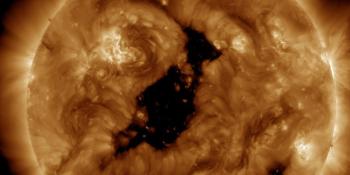
Coronal hole faces Earth
X1.5 solar flare
M2.7 solar flare, CME arrival possible
Últimas mensagens do fórum
Mais tópicosApoie o SpaceWeatherLive.com!
Muitas pessoas vêm ao SpaceWeatherLive para acompanhar a atividade solar ou se houver uma chance de ver a aurora, mas com mais tráfego, os custos para manter os servidores online aumentam. Se você gosta do SpaceWeatherLive e quer apoiar o projeto, pode escolher uma subscrição para um site sem anúncios ou considerar uma doação. Com a sua ajuda, podemos manter o SpaceWeatherLive online!



Fatos sobre o clima espacial
| Última explosão X | 24/04/2026 | X2.5 |
| Última explosão M | 22/05/2026 | M2.3 |
| Última tempestade geomagnética | 16/05/2026 | Kp6- (G2) |
| Dias impecáveis | |
|---|---|
| Últimos 365 dias | 3 dias |
| 2026 | 3 dias (2%) |
| Último dia sem manchas | 24/02/2026 |
| Número médio mensal de manchas solares | |
|---|---|
| abril 2026 | 79.3 -6.6 |
| maio 2026 | 87.5 +8.2 |
| Últimos 30 dias | 98 +7.5 |