Previsão do Clima Espacial - Discussão
Publicado: 2026 May 24 1230 UTC
Preparado pelo Departamento de Comércio dos EUA, NOAA, Centro de Previsão do Clima Espacial e processado por SpaceWeatherLive.com
Atividade solar
Resumo das últimas 24h
Solar activity remained at low levels. The majority of the C-class activity originated from the eastern and western limbs of the Sun. The strongest flare was a C5.5 flare at 23/2204 UTC. Region 4441 (N08W78, ESO/beta) was responsible for a C2.8 flare at 23/1954 UTC. This event also produced a Type II radio sweep (est. 932 km/s). The CME signatures identified in available coronagraph imagery were associated with activity on or behind the Suns limb. No Earth-directed components were suspected. Newly numbered Region 4447 (S15E32, Dao/beta) was a separation of the northern spots from Region 4444 (S21E36, Hsx/alpha).Previsão
Solar activity is expected to remain at low levels, with a chance for isolated M-class flares (R1-R2/Minor-Moderate) on 24-26 May, primarily due to the flare potential of Region 4441 and Region 4446.Partículas Energéticas
Resumo das últimas 24h
The greater than 2 MeV electron flux at geosynchronous orbit remained at moderate to high levels, reaching a peak level of 4,016 pfu at 23/1555 UTC. The greater than 10 MeV proton flux at geosynchronous orbit remained at background levels.Previsão
The greater than 2 MeV electron flux is expected to remain at moderate to high levels on 24-25 May before returning to low to moderate levels on 26 May. The greater than 10 MeV proton flux is expected to remain at background levels through 26 May.Vento Solar
Resumo das últimas 24h
Solar wind parameters reflected near-background conditions. Wind speeds were between 290-330 km/s, total magnetic field strength varied from 3-5 nT. The phi angle was predominantly in a negative orientation.Previsão
Primarily ambient conditions are expected for 24-25 May under a background solar wind regime. Late on 26 May, enhancements to the solar wind environment are possible with the anticipated onset of a negative polarity CH HSS.Geoespaço
Resumo das últimas 24h
The geomagnetic field was at quiet levels.Previsão
Mostly quiet levels are anticipated on 24-25 May under a near-background solar regime. Periods of unsettled conditions are possible, with a chance for an isolated active period, late on 26 May with the likely onset of an approaching -CH HSS.Últimas notícias
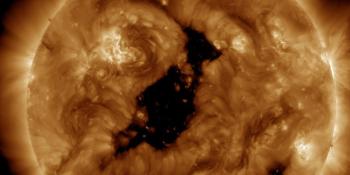
quarta-feira, 13 maio 2026
Coronal hole faces Earth
segunda-feira, 30 março 2026
X1.5 solar flare
terça-feira, 17 março 2026
M2.7 solar flare, CME arrival possible
Últimas mensagens do fórum
Mais tópicosApoie o SpaceWeatherLive.com!
Muitas pessoas vêm ao SpaceWeatherLive para acompanhar a atividade solar ou se houver uma chance de ver a aurora, mas com mais tráfego, os custos para manter os servidores online aumentam. Se você gosta do SpaceWeatherLive e quer apoiar o projeto, pode escolher uma subscrição para um site sem anúncios ou considerar uma doação. Com a sua ajuda, podemos manter o SpaceWeatherLive online!



Fatos sobre o clima espacial
| Última explosão X | 24/04/2026 | X2.5 |
| Última explosão M | 22/05/2026 | M2.3 |
| Última tempestade geomagnética | 16/05/2026 | Kp6- (G2) |
| Dias impecáveis | |
|---|---|
| Últimos 365 dias | 3 dias |
| 2026 | 3 dias (2%) |
| Último dia sem manchas | 24/02/2026 |
| Número médio mensal de manchas solares | |
|---|---|
| abril 2026 | 79.3 -6.6 |
| maio 2026 | 87.5 +8.2 |
| Últimos 30 dias | 98 +7.5 |
Este dia na história*
Aurora mestre dois na história
Nenhuma observação foi submetido neste dia na história. Se você observou a aurora e tem fotos incríveis para mostrar, envie suas observações agora!
Envie sua observação da aurora