Previsioni Meteorologiche Spaziali - Discussione
Emesso: 2026 May 21 1230 UTC
Preparati dal Dipartimento di Commercio degli Stati Uniti, NOAA, Centro di Previsione Meteorologica Spaziale e elaborati da SpaceWeatherLive.com
Attività solare
Sommario di 24 ore
Solar activity was at very low levels during the past 24 hours. Region 4441 (N07W37, Eai/beta-gamma) showed some magnetic development during the period. The other numbered regions were stable or in decay. New Region 4444 (S20E76, Hsx/alpha) was numbered and was inactive. There was a CME off the NW limb that appears to have originated in the vicinity of Region 4436 (N19W78, Cso/beta). This event was first visible in LASCO C2 imagery at 20/1612 UTC. This event is being analyzed for potential impacts at the time of this summary.Previsione
Solar activity is expected to remain at low levels through 23 May, with a slight chance for isolated M-class flares (R1-R2/Minor-Moderate) on 21 May, primarily due to the complexity of Region 4441 and the recent flaring history of Region 4436. An increased in activity is anticipated 22-23 May as multiple active regions, tracked via far-side satellite and helioseismology imagery, rotate into view.Particelle energetiche
Sommario di 24 ore
The greater than 2 MeV electron flux at geosynchronous orbit remained at high levels, reaching a peak level of 1720 pfu at 20/1615 UTC. The greater than 10 MeV proton flux at geosynchronous orbit remained at background levels.Previsione
The greater than 2 MeV electron flux is expected to return to normal to moderate levels on 21 May as current conditions wane. A return to high levels is anticipated on 22-23 May following the geoeffective onset of a new coronal hole high-speed stream. The greater than 10 MeV proton flux is expected to remain at background levels through 23 May.Vento Solare
Sommario di 24 ore
Solar wind parameters trended toward background conditions with speeds reaching a peak of 542 km/s at 20/0222Z and then decreasing steadily throughout the reporting period, ending at ~430 km/s. Total IMF reached 6 nT while the maximum southward component of Bz reached -5 nT The phi angle remained on the negative sector.Previsione
Solar wind parameters are expected to continue trending toward nominal conditions through early on 21 May. Mild enhancements are likely on 21 May from a solar sector boundary crossing, with more pronounced high-speed stream conditions expected on 22-23 May due to the influences of a positive polarity coronal hole high-speed stream (+CH HSS).Geospaziale
Sommario di 24 ore
The geomagnetic field has been at quiet to unsettled levels for the past 24 hours.Previsione
Isolated active periods are likely on 21 May following an anticipated sector boundary crossing and the onset of the approaching +CH HSS. Quiet to unsettled levels are anticipated 22-23 May due to persisting +CH HSS influences.Ultime notizie
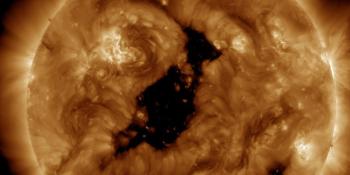
mercoledì, 13 maggio AM
Coronal hole faces Earth
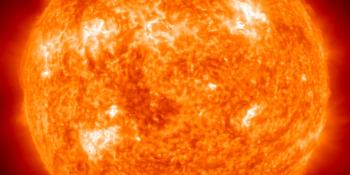
lunedì, 30 marzo PM
X1.5 solar flare
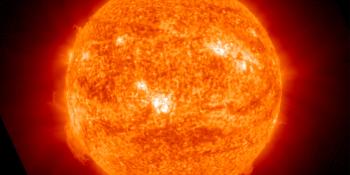
martedì, 17 marzo PM
M2.7 solar flare, CME arrival possible
Ultimi messaggi dal forum
Current Farside Activity 571Space Weather Memes 832Unspecified geomagnetic activity 258Incoming & Unnumbered Active Regions 390Coronal Hole 53 101
Altri argomentiSupporta SpaceWeatherLive.com!
A lot of people come to SpaceWeatherLive to follow the Solar activity or if there is a chance to see the aurora, but with more traffic comes higher costs to keep the servers online. If you like SpaceWeatherLive and want to support the project you can choose a subscription for an ad-free site or consider a donation. With your help we can keep SpaceWeatherLive online!



Notizie sul meteo spaziale
| Ultimo brillamento X | 2026/04/24 | X2.5 |
| Ultimo brillamento M | 2026/05/17 | M1.4 |
| Ultima tempesta geomagnetica | 2026/05/16 | Kp6- (G2) |
| Giorni senza macchie | |
|---|---|
| Ultimi 365 giorni | 3 giorni |
| 2026 | 3 giorni (2%) |
| Ultimo giorno senza macchie | 2026/02/24 |
| Media mensile Numero di Macchie Solari | |
|---|---|
| aprile 2026 | 79.3 -6.6 |
| maggio 2026 | 89.2 +9.9 |
| Ultimi 30 giorni | 99.3 +7.6 |
Questo giorno nella storia*
Aurora on this day in history
No observations submitted for this day in history. If you've observed the aurora and you have some amazing photos to show off, submit your observations now!
Submit your aurora observation