Het archief bekijken van zaterdag 24 januari 2026
Dagelijks bulletin over zonne- en geomagnetische activiteit van het SIDC
Datum verslag: 2026 Jan 24 1253 UTC
SIDC Prognose
Zonnevlammen
M-class flares expected (probability >=50%)
Geomagnetisme
Quiet (A<20 and K<4)
Proton Flux monitor
Warning condition (activity levels expected to increase, but no numeric forecast given)
| 10cm flux | Ap | |
|---|---|---|
| 24 Jan 2026 | 174 | 007 |
| 25 Jan 2026 | 175 | 007 |
| 26 Jan 2026 | 175 | 007 |
Zonnevlekkengebieden en zonnevlammen
Solar flaring activity was very low over the past 24 hours, with the soft X-ray flux remaining below C level for most of the period. A total of 10 numbered sunspot groups were identified on the disk, with additional short-lived groups emerging and disappearing. A long-duration C5.9 flare was observed on 2026 Jan 23 (start 21:41 UTC, peak 23:29 UTC) from near latitude -24 on the east limb; given its limb location, the flare may have been partially occulted and could have been larger if the source was just behind the limb, and such events are often associated with CME activity. On the visible disk, the largest identified flare was a C4.1 event (SIDC Flare 6725) peaking on January 24 at 08:31 UTC, produced by SIDC Sunspot Group 768 (NOAA Active Region 4351). Solar flaring activity is expected to be moderate over the next 24 hours, with C-class flares expected and M-class flares likely.
Coronale massa uitstoten
Two halo coronal mass ejections (CMEs) were automatically detected by the CACTus tool over the past 24 hours. The first event was first detected on 2026 Jan 23 at 15:12 UTC, with a central position angle near 141 degrees, an angular width of about 180 degrees, and a projected speed of roughly 600-700 km/s. No clear source signature was identified on the visible solar disk, and the event is therefore considered likely backside. A second event was first detected on 2026 Jan 23 at 22:35 UTC, with a central position angle near 123 degrees, an angular width of about 208 degrees, and a projected speed of roughly 800-900 km/s. The CME appears to originate just behind the limb, as associated coronal dimming extended up to the visible disk. Given this geometry, the CME is also considered likely backside, with no Earth-directed component expected. No Earth-directed coronal mass ejection (CME) were observed in SOHO/LASCO images over the past 24 hours.
Coronale gaten
SIDC Coronal Hole 146 (trans-equatorial coronal hole with a positive polarity) first reached the central meridian on January 16 and is now partially positioned on the western side of the Sun. A new SIDC Coronal Hole 147 (equatorial coronal hole with a negative polarity) is positioned on the Eastern side of the Sun, and is expected to cross the central meridian tomorrow.
Zonnewind
Over the past 24 hours, solar wind conditions were moderately elevated and fairly steady. Solar wind speed ranged from about 480 km/s to about 640 km/s and remained mostly near 520 to 600 km/s. The interplanetary magnetic field (IMF) stayed at low to moderate levels, with the total IMF Bt between about 4 and 8 nT, while the north south component Bz fluctuated between about -6 nT and +6 nT without long-lasting strongly southward intervals. Overall, these signatures are consistent with a continuing recovery toward more typical solar wind conditions, although speeds remain somewhat elevated.
Geomagnetisme
Geomagnetic activity was mostly active earlier in the interval and then eased. Globally, NOAA Kp was around active levels (about Kp 4) for much of the afternoon and evening of January 23 through early January 24, before decreasing to unsettled levels (around Kp 2) after about 03:00 UTC. Over Belgium, K_BEL reached active to minor storm levels, peaking near 5 during the evening of January 23 (around 18:00 to 22:00 UTC), then decreased to mostly 2 to 3 overnight, with a return to active levels (around 4) later in the morning. Further unsettled to active intervals remain possible, with a low chance of minor storming if Bz turns persistently southward while solar wind speed stays elevated.
Proton flux niveaus
The solar energetic particle event associated with the X1.9 flare (SIDC Flare 6678, peaking on 2026 Jan 18 at 18:09 UTC) remained ongoing until 2026 Jan 22 at 08:35 UTC, when the greater than 10 MeV GOES proton flux dropped below the 10 pfu threshold. The greater than 10 MeV flux is expected to continue to decay toward background levels. A new solar energetic particle event cannot be excluded given the number of sunspot groups currently on the visible disk, in particular the most magnetically complex regions.
Elektronenfluxen in geostationaire baan
The greater than 2 MeV GOES electron flux stayed above to the 1000 pfu alert threshold over the past 24 hours. In response of the elevated solar wind speed in the past 4 days, the greater than 2 MeV electron flux may remain near or above the threshold during the next 24 hours. The 24-hour electron fluence remained at moderate levels and is expected to stay around these levels, with a possible increase if elevated electron flux persists.
Het geschatte internationale zonnevlekkengetal (ISN) van vandaag: 158, gebaseerd op 12 stations.Zon indexen voor 23 Jan 2026
| Wolfgetal Catania | 216 |
| 10cm zonneflux | 180 |
| AK Chambon La Forêt | 046 |
| AK Wingst | 030 |
| Geschatte Ap | 032 |
| Geschat internationaal zonnevlekkengetal | 168 - Gebaseerd op 11 stations |
Overzicht opvallende gebeurtenissen
| Dag | Start | Max | Einde | Locatie | Sterkte | OP | 10cm | Catania/NOAA | Soorten radio-uitbarstingen | |
|---|---|---|---|---|---|---|---|---|---|---|
| Geen | ||||||||||
Aangeboden door het Solar Influences Data Analysis Center© - SIDC - Verwerkt door SpaceWeatherLive
Alle tijden in UTC
<< Keer terug naar de dagelijkse overview pagina
Laatste nieuws
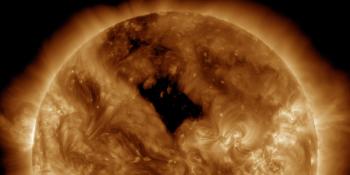
Coronal hole faces Earth
Total solar eclipse august 12th 2026
X1.1 solar flare, G2 watch
Laatste forumberichten
Steun Poollicht.be!
Veel mensen komen naar Poollicht.be om de zonneactiviteit te volgen of om het poollicht te zien, maar met meer bezoekers komen er hogere kosten bij om de servers online te houden. Als je Poollicht.be leuk vindt en het project wilt steunen, kun je kiezen voor een abonnement op een advertentievrije website of een donatie overwegen. Met jouw hulp kunnen we Poollicht. be online houden!



Ruimteweer feitjes
| Laatste X-klasse uitbarsting | 04/07/2026 | X1.3 |
| Laatste M-klasse uitbarsting | 05/09/2026 | M1.0 |
| Laatste geomagnetische storm | 08/09/2026 | Kp5 (G1) |
| Zonnevlekkenloze dagen | |
|---|---|
| Afgelopen 365 dagen | 4 dagen |
| 2026 | 4 dagen (2%) |
| Laatste zonnevlekkenloze dag | 18/09/2026 |
| Maandelijks gemiddeld zonnevlekkengetal | |
|---|---|
| augustus 2026 | 76 -2.1 |
| september 2026 | 64 -12 |
| Afgelopen 30 dagen | 70.2 -18 |