Het archief bekijken van vrijdag 3 juli 2026
Dagelijks bulletin over zonne- en geomagnetische activiteit van het SIDC
Datum verslag: 2026 Jul 03 1236 UTC
SIDC Prognose
Zonnevlammen
M-class flares expected (probability >=50%)
Geomagnetisme
Minor storm expected (A>=30 or K=5)
Proton Flux monitor
Warning condition (activity levels expected to increase, but no numeric forecast given)
| 10cm flux | Ap | |
|---|---|---|
| 03 Jul 2026 | 200 | 034 |
| 04 Jul 2026 | 200 | 013 |
| 05 Jul 2026 | 200 | 007 |
Zonnevlekkengebieden en zonnevlammen
Solar flaring activity was moderate over the past 24 hours, with one M-class flare and several C-class flares identified. The largest flare was an M1.2 flare, SIDC Flare 8096, peaking on July 02 at 23:12 UTC, produced by SIDC Sunspot Group 860 (NOAA Active Region 4479). A total of 4 numbered sunspot groups were identified on the visible solar disk over the past 24 hours. SIDC Sunspot Group 860, currently located at N16W56, had a beta-gamma-delta magnetic configuration, continued to grow, and accounted for most of the flaring activity during the period. SIDC Sunspot Group 901 (NOAA Active Region 448) currently located at S18W62, had a beta-gamma magnetic configuration and produced several C-class flares. SIDC Sunspot Group 886 (NOAA Active Region 4478) currently located at S06W36, had a beta-gamma magnetic configuration and remained stable. Solar flaring activity is expected to remain moderate over the next 24 hours, with C-class flares expected, M-class flares very likely, and a small chance for X-class flares.
Coronale massa uitstoten
Three successive Coronal Mass Ejections, CMEs, were observed from July 01 to July 02, associated with repeated eruptive activity from SIDC Sunspot Group 860 (NOAA Active Region 4479), located in the northwestern quadrant of the solar disk. The first CME was a very faint and slow NNW-directed event first seen in SOHO/LASCO C2 from around 12:12 UTC on July 01. It was most likely associated with an M-class flare from SIDC Sunspot Group 860. The plane of the sky speed was estimated around 250-300 km/s. The second CME was associated with the M3.5 flare (SIDC Flare 8084) from SIDC Sunspot Group 860 peaking at 19:43 UTC on July 01. Due to a LASCO data gap, the CME was first clearly seen in SOHO/LASCO C2 from around 00:00 UTC on July 02, although the estimated CME onset time was around 21:00 UTC on July 01. In the plane of the sky, the CME appeared mainly directed northward with a speed of about 400 km/s. The true speed was then estimated of about 650 km/s. Finally the third CME was associated with the M4.2 flare (SIDC Flare 8090) from SIDC Sunspot Group 860 peaking at 01:56 UTC on July 02. The CME was first seen in SOHO/LASCO C2 from around 02:36 UTC on July 02. It consisted of a brighter northern ejecta component and a much wider faint shock-like front. The projected CACTUS signature had a projected speed of about 600 km/s. And the true speed was estimated of about 850 km/s. The combined arrival of the associated interplanetary CME structures is expected around July 05 around 12:00 UTC, with an uncertainty of about +/- 12 hours. The associated geomagnetic response may reach active to minor storm conditions, with Kp values possibly in the 4 to 6 range.
Coronale gaten
A recurrent positive polarity coronal hole, SIDC Coronal Hole 159, associated with the high-latitude extension of the southern polar coronal hole, was observed in the southern hemisphere. Its extension reached the southern mid-latitudes and was first crossing the central meridian on June 30.
Zonnewind
Solar wind conditions near Earth were mostly in the slow solar wind regime over the past 24 hours, until a solar wind shock was observed around 11:20 UTC on July 03. This is likely related to the arrival of SIDC Coronal Mass Ejection (CME) 679, first observed in SOHO/LASCO C2 around 21:00 UTC on June 30. The solar wind speed increased sharply from about 350 km/s to 420 km/s, and then increased further, reaching values close to 490 km/s. The total interplanetary magnetic field, Bt, increased sharply from about 6 nT to 11 nT, reaching up to around 12.5 nT. The Bz component fluctuated between about -6 nT and +9 nT after the arrival, with no sustained strongly southward interval observed so far. The arrival was also visible in the solar wind density, which showed a sudden sharp increase at the same time. Enhanced solar wind conditions are expected over the next 24 hours due to the passage of the associated interplanetary SIDC CME 679 structure. A contribution from the high-speed stream associated with the positive polarity southern polar coronal hole, SIDC Coronal Hole 159, cannot be excluded, although the probability of arrival remains low due to the southern location of the coronal-hole extension. A further enhancement of the solar wind conditions is possible from July 05 onwards due to the possible combined arrival of the interplanetary structures associated with the three successive CMEs, SIDC CME 680, SIDC CME 681, and SIDC CME 682, observed on July 01 and July 02 from SIDC Sunspot Group 860 (NOAA Active Region 4479). The predicted combined arrival time is around July 05 at 12:00 UTC, with an uncertainty of about +/-12 hours.
Geomagnetisme
Geomagnetic conditions were quiet globally and quiet to unsettled locally over the past 24 hours, with NOAA Kp remaining at quiet levels and K BEL reaching 3. Minor storm to storm geomagnetic conditions are expected over the next 24 hours in response to the arrival and passage of the interplanetary structure associated with SIDC CME 679. The geomagnetic response will depend mainly on the strength and duration of any southward Bz interval. A further enhancement is possible from late July 05 onwards due to the possible combined arrival of the interplanetary structures associated with the three successive CMEs, SIDC CME 680, SIDC CME 681, and SIDC CME 682, observed on July 01 and July 02 from SIDC Sunspot Group 860, NOAA Active Region 4479. Active to minor storm conditions are possible, with Kp values possibly reaching 4 to 6.
Proton flux niveaus
The greater than 10 MeV proton flux, as measured by GOES, remained at background levels over the past 24 hours and is expected to remain at background levels over the next 24 hours. However, a proton flux enhancement cannot be fully excluded in case of further significant flaring activity, in particular from the complex regions currently on the visible disk, including SIDC Sunspot Groups 860 and 886 in the western hemisphere.
Elektronenfluxen in geostationaire baan
The greater than 2 MeV electron flux, as measured by GOES, remained below the 1000 pfu threshold over the past 24 hours and is expected to remain below the threshold over the next 24 hours. The 24h electron fluence was at normal levels and is expected to remain at normal levels over the next 24 hours.
Het geschatte internationale zonnevlekkengetal (ISN) van vandaag: 113, gebaseerd op 21 stations.Zon indexen voor 02 Jul 2026
| Wolfgetal Catania | 157 |
| 10cm zonneflux | 203 |
| AK Chambon La Forêt | 006 |
| AK Wingst | 005 |
| Geschatte Ap | 003 |
| Geschat internationaal zonnevlekkengetal | 124 - Gebaseerd op 28 stations |
Overzicht opvallende gebeurtenissen
| Dag | Start | Max | Einde | Locatie | Sterkte | OP | 10cm | Catania/NOAA | Soorten radio-uitbarstingen |
|---|---|---|---|---|---|---|---|---|---|
| 02 | 1021 | 1026 | 1028 | S19W49 | M2.8 | SN | 61/4480 | VI/2III/3 | |
| 02 | 2303 | 2312 | 2316 | ---- | M1.2 | 62/4479 |
Aangeboden door het Solar Influences Data Analysis Center© - SIDC - Verwerkt door SpaceWeatherLive
Alle tijden in UTC
<< Keer terug naar de dagelijkse overview pagina
Laatste nieuws
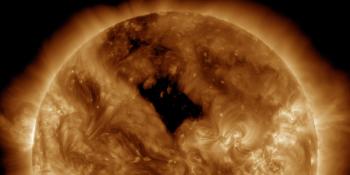
Coronal hole faces Earth
Total solar eclipse august 12th 2026
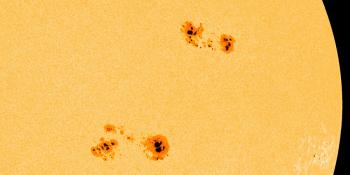
X1.1 solar flare, G2 watch
Laatste forumberichten
Steun Poollicht.be!
Veel mensen komen naar Poollicht.be om de zonneactiviteit te volgen of om het poollicht te zien, maar met meer bezoekers komen er hogere kosten bij om de servers online te houden. Als je Poollicht.be leuk vindt en het project wilt steunen, kun je kiezen voor een abonnement op een advertentievrije website of een donatie overwegen. Met jouw hulp kunnen we Poollicht. be online houden!



Ruimteweer feitjes
| Laatste X-klasse uitbarsting | 04/07/2026 | X1.3 |
| Laatste M-klasse uitbarsting | 05/09/2026 | M1.0 |
| Laatste geomagnetische storm | 08/09/2026 | Kp5 (G1) |
| Zonnevlekkenloze dagen | |
|---|---|
| Afgelopen 365 dagen | 4 dagen |
| 2026 | 4 dagen (2%) |
| Laatste zonnevlekkenloze dag | 18/09/2026 |
| Maandelijks gemiddeld zonnevlekkengetal | |
|---|---|
| augustus 2026 | 76 -2.1 |
| september 2026 | 64 -12 |
| Afgelopen 30 dagen | 70.1 -18 |