Het archief bekijken van woensdag 26 augustus 2026
Dagelijks bulletin over zonne- en geomagnetische activiteit van het SIDC
Datum verslag: 2026 Aug 26 1231 UTC
SIDC Prognose
Zonnevlammen
M-class flares expected (probability >=50%)
Geomagnetisme
Active conditions expected (A>=20 or K=4)
Proton Flux monitor
Quiet
| 10cm flux | Ap | |
|---|---|---|
| 26 Aug 2026 | 130 | 005 |
| 27 Aug 2026 | 128 | 022 |
| 28 Aug 2026 | 128 | 030 |
Zonnevlekkengebieden en zonnevlammen
Solar flaring activity was moderate over the past 24 hours, with one M-class flare recorded. The largest flare was an M2.2 flare (SIDC Flare 8468), peaking at 06:34 UTC on August 26, associated with SIDC Sunspot Group 929 (NOAA Active Region 4513; magnetic type beta-gamma-delta). Type II radio emission was detected at 06:35 UTC during the flaring activity, with an estimated velocity of 930 km/s. There are currently four numbered active regions on the visible solar disk. SIDC Sunspot Group 929, which remains the most complex active region on the solar disk, was the main driver of the flaring activity observed over the past 24 hours. SIDC Sunspot Group 860 (NOAA Active Region 4516; magnetic type beta), which is expected to rotate over the west solar limb in the next hours, remained quiet. The remaining active regions are relatively simple (magnetic type alpha or beta) and did not produce any significant flaring activity. Solar flaring activity is expected to be at moderate levels over the next 24 hours, with C-class flares expected and M-class flares likely.
Coronale massa uitstoten
A coronal mass ejection (SIDC CME 714) was detected in SOHO/LASCO-C2 coronagraph imagery starting at around 11:00 UTC on August 25. The CME was directed primarily toward the east from Earth's perspective and was associated with the M6.9 flare (SIDC Flare 8465), peaking at 10:02 UTC on August 25, produced by SIDC Sunspot Group 929 (NOAA Active Region 4513). The CME may have an Earth-directed component, with a possible arrival at Earth on August 28. On-disk coronal dimming was also observed near SIDC Sunspot Group 929 (NOAA Active Region 4513), associated with the M2.2 flare (SIDC Flare 8468), peaking at 06:34 UTC on August 26. Any corresponding CME will be analysed once coronagraph data become available.
Zonnewind
Over the past 24 hours, solar wind parameters (SOLAR-1 and ACE) reflected slow solar wind conditions. The solar wind speed ranged between 300 and 340 km/s. The interplanetary magnetic field remained below 6 nT. The magnetic field orientation was predominantly in the negative sector (field directed towards the Sun). Slow solar wind conditions are expected to prevail over the next days, with the possibility of a weak enhancement from August 27 due to the anticipated arrival of a high-speed stream from a positive polarity coronal hole (SIDC Coronal Hole 159). A further enhancement is possible on August 28 due to the possible arrival of SIDC CME 714, which lifted off the Sun on August 25.
Geomagnetisme
Geomagnetic conditions over the past 24 hours were quiet both globally and locally over Belgium (NOAA Kp = 1 to 2; K-Bel = 1 to 2). Mostly quiet geomagnetic conditions are expected over the next hours. From August 27, unsettled to active geomagnetic conditions are expected, with a chance of reaching minor storm levels due to the anticipated arrival of a high-speed stream from a positive polarity coronal hole (SIDC Coronal Hole 159). On August 28, active conditions are expected, with a chance of isolated minor or moderate storm periods due to the possible arrival of SIDC CME 714, which lifted off the Sun on August 25.
Proton flux niveaus
Over the past 24 hours, the greater than 10 MeV GOES proton flux was still slightly elevated but remained well below the 10 pfu threshold. The proton flux is expected to remain below the 10 pfu threshold over the next 24 hours.
Elektronenfluxen in geostationaire baan
The greater than 2 MeV electron flux, as measured by GOES-18 and GOES-19, fluctuated around the 1000 pfu alert threshold over the past 24 hours. The greater than 2 MeV electron flux may exceed the alert threshold again over the next 24 hours. The 24-hour electron fluence was at moderate levels and is expected to remain at moderate levels over the next 24 hours.
Het geschatte internationale zonnevlekkengetal (ISN) van vandaag: 086, gebaseerd op 18 stations.Zon indexen voor 25 Aug 2026
| Wolfgetal Catania | 086 |
| 10cm zonneflux | 132 |
| AK Chambon La Forêt | 006 |
| AK Wingst | 004 |
| Geschatte Ap | 003 |
| Geschat internationaal zonnevlekkengetal | 083 - Gebaseerd op 24 stations |
Overzicht opvallende gebeurtenissen
| Dag | Start | Max | Einde | Locatie | Sterkte | OP | 10cm | Catania/NOAA | Soorten radio-uitbarstingen |
|---|---|---|---|---|---|---|---|---|---|
| 25 | 0932 | 1002 | 1013 | N03E06 | M6.9 | 1B | 13/4513 | II/3 | |
| 26 | 0629 | 0634 | 0638 | N04E15 | M2.2 | 1B | 13/4513 | III/1II/2 |
Aangeboden door het Solar Influences Data Analysis Center© - SIDC - Verwerkt door SpaceWeatherLive
Alle tijden in UTC
<< Keer terug naar de dagelijkse overview pagina
Laatste nieuws
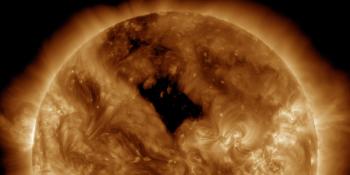
Coronal hole faces Earth

Total solar eclipse august 12th 2026
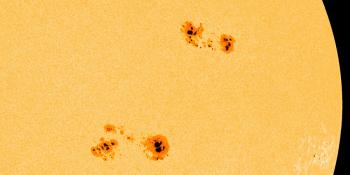
X1.1 solar flare, G2 watch
Laatste forumberichten
Steun Poollicht.be!
Veel mensen komen naar Poollicht.be om de zonneactiviteit te volgen of om het poollicht te zien, maar met meer bezoekers komen er hogere kosten bij om de servers online te houden. Als je Poollicht.be leuk vindt en het project wilt steunen, kun je kiezen voor een abonnement op een advertentievrije website of een donatie overwegen. Met jouw hulp kunnen we Poollicht. be online houden!



Ruimteweer feitjes
| Laatste X-klasse uitbarsting | 04/07/2026 | X1.3 |
| Laatste M-klasse uitbarsting | 05/09/2026 | M1.0 |
| Laatste geomagnetische storm | 08/09/2026 | Kp5 (G1) |
| Zonnevlekkenloze dagen | |
|---|---|
| Afgelopen 365 dagen | 4 dagen |
| 2026 | 4 dagen (2%) |
| Laatste zonnevlekkenloze dag | 18/09/2026 |
| Maandelijks gemiddeld zonnevlekkengetal | |
|---|---|
| augustus 2026 | 76 -2.1 |
| september 2026 | 64 -12 |
| Afgelopen 30 dagen | 70.2 -18 |