Het archief bekijken van vrijdag 11 juli 2025
Dagelijks bulletin over zonne- en geomagnetische activiteit van het SIDC
Datum verslag: 2025 Jul 11 1231 UTC
SIDC Prognose
Zonnevlammen
M-class flares expected (probability >=50%)
Geomagnetisme
Active conditions expected (A>=20 or K=4)
Proton Flux monitor
Quiet
| 10cm flux | Ap | |
|---|---|---|
| 11 Jul 2025 | 132 | 019 |
| 12 Jul 2025 | 136 | 021 |
| 13 Jul 2025 | 138 | 021 |
Zonnevlekkengebieden en zonnevlammen
Solar flaring activity was low over the past 24 hours, with only C-class flares identified. The largest flare was a C8.9 flare (SIDC Flare 4828) peaking on July 10 at 19:36 UTC, which erupted behind the Suns east limb. A total of 8 numbered sunspot groups were identified on the disk over the past 24 hours. SIDC Sunspot Group 522 (NOAA Active Region 4136) is the largest region on disk and has a Beta-Gamma magnetic configuration. SIDC Sunspot Group 552 has emerged near the center of the disk and has a Beta-Gamma magnetic configuration. Solar flaring activity is expected to be moderate over the next 24 hours, with C-class flares expected and M-class flares likely.
Coronale massa uitstoten
No Earth-directed Coronal Mass Ejections (CMEs) have been detected in the available coronagraph images.
Coronale gaten
Returning SIDC Coronal Hole 104 (low to mid latitude coronal hole with a positive polarity) started to cross the central meridian on July 08 and is continuing to cross the central meridian.
Zonnewind
Over the past 24 hours the solar wind conditions at Earth became disturbed, due to the arrival of a high-speed stream (HSS), associated with SIDC Coronal Hole 104. The solar wind speed jumped, around 04:50 UTC on July 11, from 337 km/s to 411 km/s, reaching a peak of 470 km/s. The total interplanetary magnetic field ranged from 1 nT to 14 nT, with the Bz component reaching a minimum of -11 nT. The phi-angle was mainly in the positive sector (directed away from the Sun), with periods in the negative sector. The solar wind conditions are expected to remain disturbed in the next 24, due to the influence of the HSS.
Geomagnetisme
The geomagnetic conditions over the past 24 hours were globally and locally quiet to unsettled (Kp 1 - 3 & K BEL 1 - 3). Active conditions are expected for the next 24 hours.
Proton flux niveaus
Over the past 24 hours, the greater than 10 MeV GOES proton flux was at background levels and is expected to remain so over the next days.
Elektronenfluxen in geostationaire baan
The greater than 2 MeV electron flux, as measured by the GOES-18 and GOES-19 satellites, were above the 1000 pfu threshold until 03:35 UTC on July 11 when it decreased below the threshold. During the next 24 hours, there’s a chance that the electron flux exceeds the 1000 pfu threshold again due to the influence of an HSS. The 24-hour electron fluence was at moderate levels and is expected to return to nominal over the next 24 hours.
Het geschatte internationale zonnevlekkengetal (ISN) van vandaag: 095, gebaseerd op 21 stations.Zon indexen voor 10 Jul 2025
| Wolfgetal Catania | 067 |
| 10cm zonneflux | 129 |
| AK Chambon La Forêt | 010 |
| AK Wingst | 003 |
| Geschatte Ap | 003 |
| Geschat internationaal zonnevlekkengetal | 079 - Gebaseerd op 31 stations |
Overzicht opvallende gebeurtenissen
| Dag | Start | Max | Einde | Locatie | Sterkte | OP | 10cm | Catania/NOAA | Soorten radio-uitbarstingen | |
|---|---|---|---|---|---|---|---|---|---|---|
| Geen | ||||||||||
Aangeboden door het Solar Influences Data Analysis Center© - SIDC - Verwerkt door SpaceWeatherLive
Alle tijden in UTC
<< Keer terug naar de dagelijkse overview pagina
Laatste nieuws
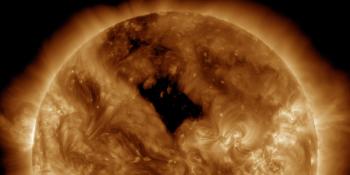
Coronal hole faces Earth
Total solar eclipse august 12th 2026
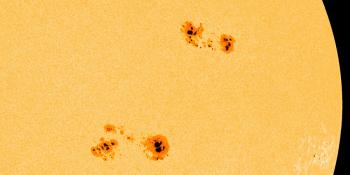
X1.1 solar flare, G2 watch
Laatste forumberichten
Steun Poollicht.be!
Veel mensen komen naar Poollicht.be om de zonneactiviteit te volgen of om het poollicht te zien, maar met meer bezoekers komen er hogere kosten bij om de servers online te houden. Als je Poollicht.be leuk vindt en het project wilt steunen, kun je kiezen voor een abonnement op een advertentievrije website of een donatie overwegen. Met jouw hulp kunnen we Poollicht. be online houden!


Ruimteweer feitjes
| Laatste X-klasse uitbarsting | 04/07/2026 | X1.3 |
| Laatste M-klasse uitbarsting | 05/09/2026 | M1.0 |
| Laatste geomagnetische storm | 08/09/2026 | Kp5 (G1) |
| Zonnevlekkenloze dagen | |
|---|---|
| Afgelopen 365 dagen | 4 dagen |
| 2026 | 4 dagen (2%) |
| Huidige periode | 2 dagen |
| Maandelijks gemiddeld zonnevlekkengetal | |
|---|---|
| augustus 2026 | 76 -2.1 |
| september 2026 | 64 -12 |
| Afgelopen 30 dagen | 70.2 -18 |