Viendo archivo del domingo, 26 octubre 2014
Seleccionar la opción de archivo deseado
Informes
Actividad solar
Actividad auroral
Evolution of sunspot region 2192
Solar activity is at high levels. We already saw an X2 solar flare today from sunspot region 2192 but this sunspot region continues to be active and is now firing M-class solar flares on a regular basis. The X2 solar flare from today unfortunately did not release a coronal mass ejection. In this article we take a look how sunspot region 2192 is developing. Our header image was taken by Sajad Sayadi on October 23, 2014 at Fasa/Fars/Iran. He captured this picture of our nearest star at sunset with a great view of sunspot region 2192. He captured this shot from the Observatory & Scietific Center of Fasa (OSCF) in south Iran with a 14 inch telescope. Stunning work!
X2.0 solar flare from sunspot region 2192
...and that is number five! Sunspot region 2192 again produced a major solar flare: X2.01 (R3-strong radio blackout) at 10:56 UTC. This was already it's fifth X-class solar flare and the 13th strongest solar flare of this solar cycle... however... just like all the other X-class solar flares that we have previously seen from this sunspot region... it again looks like it did not launch a coronal mass ejection.
Últimas noticias
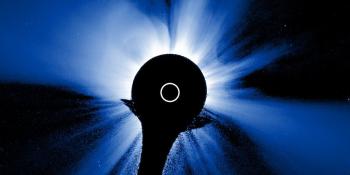
M8.1 solar flare with earth-directed CME
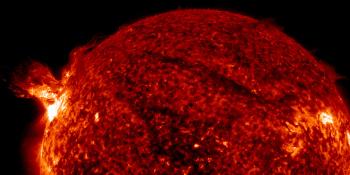
X1.9 solar flare, Coronal hole faces Earth
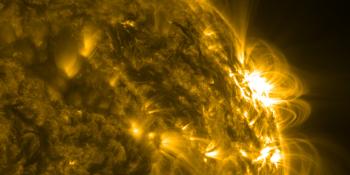
X4.0 solar flare
Últimos mensajes del foro
Apoye a SpaceWeatherLive.com!
A lot of people come to SpaceWeatherLive to follow the Solar activity or if there is a chance to see the aurora, but with more traffic comes higher costs to keep the servers online. If you like SpaceWeatherLive and want to support the project you can choose a subscription for an ad-free site or consider a donation. With your help we can keep SpaceWeatherLive online!


Hechos clima espacial
| Último evento clase X | 08/12/2025 | X1.1 |
| Último evento clase M | 12/12/2025 | M1.1 |
| Últimas tormentas geomagnéticas | 12/12/2025 | Kp5 (G1) |
| Días sin manchas | |
|---|---|
| Último día sin manchas | 08/06/2022 |
| Promedio de manchas solares mensuales | |
|---|---|
| noviembre 2025 | 91.8 -22.8 |
| diciembre 2025 | 135.1 +43.3 |
| Last 30 days | 107.1 +10.8 |