Space Weather Forecast - Debate
Emitido: 2026 Jun 23 0030 UTC
Preparado por el U.S. Dept. of Commerce, NOAA, Space Weather Prediction Center y procesado por SpaceWeatherLive.com
Actividad solar
Resumen 24 hr
Solar activity returned to low levels, with the largest flare of the period being a C1.5 at 22/0456 UTC from just behind the SE limb. Due to decreased foreshortening effects, old Region 4473 was deemed to be two separate groups and was split: Region 4473 (S09E40, Dai/beta-gamma), the western-most group that produced the M6.8 at 21/1929 UTC, and Region 4475 (S09E51, Cao/beta-gamma), the eastern-most group. Regions 4472 (S14E28, Dao/beta)exhibited minor growth. Several eruptions were seen over 20-21 Jun associated with activity from Regions 4472 and 4473, such as the M6.8. Analysis of the coronagraph imagery suggests each eruption is quite slow (~250 km/s or less); however modeling of them all together indicates that they may interact with each other and an anticipated CIR, resulting in possible minor glancing blows to Earth late on 24 Jun and potentially 28 Jun.Predicción
Solar activity is expected to continue at predominately low levels on 23-25 Jun, with a chance for M-class (R1-R2/Minor-Moderate) flares due primarily to the flare potential of Region 4473 and a region seen in Solar Orbiter data about to rotate onto the eastern limb.Partículas Energéticas
Resumen 24 hr
The greater than 2 MeV electron flux was at normal to moderate levels. The greater than 10 MeV proton flux was at background levels.Predicción
The greater than 2 MeV electron flux is expected to continue at normal to moderate levels over 23-25 Jun. The greater than 10 MeV proton flux is expected to persist at background levels through 24 Jun.Viento Solar
Resumen 24 hr
Solar wind parameters were at background levels this period, with total magnetic field strength (Bt) at or below 6 nT, no significant periods of southward Bz, phi largely positive, and solar wind speeds averaging 350 km/s. At 22/1815 UTC, a solar sector boundary crossing produced a bump in Bt, peaking at 7 nT, but no appreciable change in other solar wind parameters.Predicción
Background solar wind conditions are expected to prevail through 23 Jun. Enhanced conditions are expected 24-25 Jun due to the anticipated onset of negative polarity CH HSS influences and a potential minor glancing blow from a CME that left the Sun on 20 Jun.Geoespacio
Resumen 24 hr
The geomagnetic field was at quiet levels.Predicción
The geomagnetic field is expected to continue at mostly quiet levels through 23 Jun. Periods of active conditions are likely 24-25 Jun due to the anticipated onset of negative polarity CH HSS and glancing blow influences.Últimas noticias
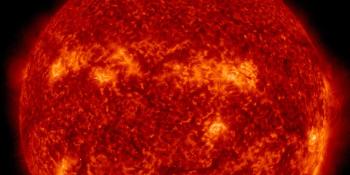
jueves, 4 junio 2026
G3 geomagnetic storm watch for 4 and 5 June
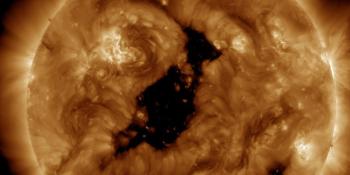
miércoles, 13 mayo 2026
Coronal hole faces Earth
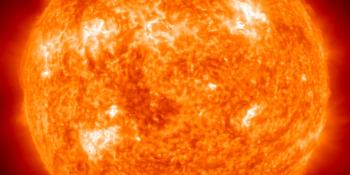
lunes, 30 marzo 2026
X1.5 solar flare
Últimos mensajes del foro
Coronal Hole 70 3SWPC Display bug or other issues 47AR4473 (featuring AR4475) 34Incoming & Unnumbered Active Regions 491Ham Radio license plates and humor. 13
Más temasApoye a SpaceWeatherLive.com!
A lot of people come to SpaceWeatherLive to follow the Solar activity or if there is a chance to see the aurora, but with more traffic comes higher costs to keep the servers online. If you like SpaceWeatherLive and want to support the project you can choose a subscription for an ad-free site or consider a donation. With your help we can keep SpaceWeatherLive online!


Hechos clima espacial
| Último evento clase X | 03/06/2026 | X1.0 |
| Último evento clase M | 21/06/2026 | M6.9 |
| Últimas tormentas geomagnéticas | 11/06/2026 | Kp5 (G1) |
| Días sin manchas | |
|---|---|
| Last 365 days | 3 días |
| 2026 | 3 días (2%) |
| Último día sin manchas | 24/02/2026 |
| Promedio de manchas solares mensuales | |
|---|---|
| mayo 2026 | 101.4 +22.1 |
| junio 2026 | 98.3 -3.1 |
| Last 30 days | 108.1 +9.3 |
Efemérides*
Aurora on this day in history
No observations submitted for this day in history. If you've observed the aurora and you have some amazing photos to show off, submit your observations now!
Submit your aurora observation