¿Qué es una mancha solar?
Sunspots form on the surface of the Sun due to strong magnetic field lines coming up from within the Sun trough the solar surface and appear visibly as dark spots compared to their surroundings. These sunspots which can become many times bigger than the Earth are always dark because they are much cooler than the surrounding surface of the Sun itself. A big sunspot can have a temperature of 3700°C. This sounds like a lot but if we compare this with the temperature of the photosphere of the Sun which is about 5500°C, then you see that there is a considerable difference. As a matter of fact, if we could take a sunspot out of the Sun and place it into our night sky it would only be as bright as the full moon, a very big contrast with the bright Sun itself.
Las manchas solares son comunes en nuestro Sol durante los años alrededor del máximo solar. Máximo solar o max solar es el período de mayor actividad solar en el ciclo solar del Sol, que dura unos 11 años. Alrededor del mínimo solar, solo se pueden encontrar muy pocas o incluso ninguna mancha solar. Las manchas solares se forman donde surgen líneas de campo magnético desde el interior del Sol a través de la superficie solar, lo que significa que cada mancha solar tiene su propia polaridad.
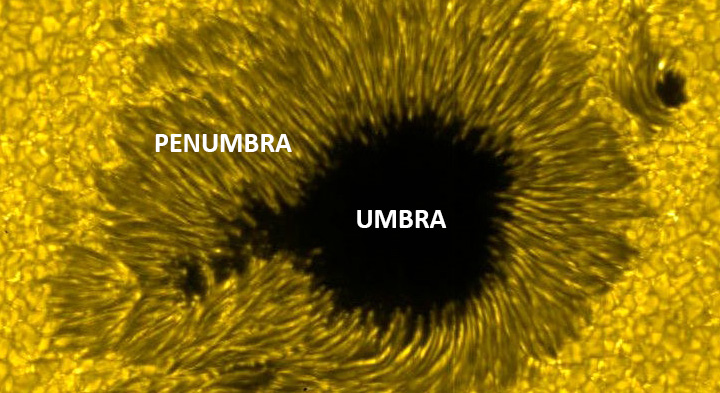
Una mancha solar consta de dos partes:
- La parte oscura (sombra)
- Parte más clara alrededor de la parte oscura (penumbra)
Regiones de manchas solares
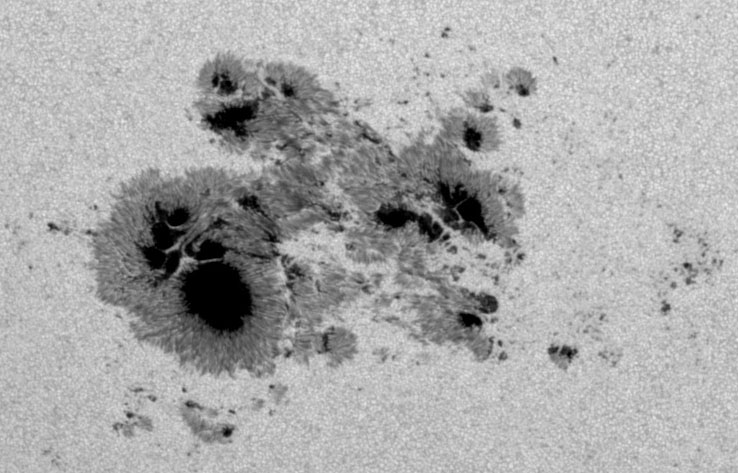
La imagen a continuación muestra un grupo grande y complejo con numerosas manchas solares. Esto se llama grupo de manchas solares o región activa. Todos los días, todas las regiones de manchas solares en el disco solar que mira a la Tierra se analizan para determinar su amenaza eruptiva y reciben un número. Esto lo hace el Centro de Predicción del Clima Espacial de NOAA. Se sabe que las regiones de manchas solares, especialmente aquellas con diseños magnéticos complejos, causan un fenómeno llamado erupciones solares.
Rotación del Sol
The Sun rotates around its axis just like Earth does. Solar features on the Sun like sunspot regions follow the rotation of the Sun. This means that a sunspot region travels across the solar disk from east to west as seen from Earth. This is important because sunspot regions need to be close to the central meridian (as seen from Earth) in order to be able to send coronal mass ejection towards Earth. It takes a sunspot region near the equator about 2 weeks to move from the east limb to west limb as seen from Earth. The further away a sunspot region is from the equator the longer it takes move across the face of the Sun. This is because the Sun rotates faster at its equator than at its poles. The rotational period is approximately 25.6 days at the equator and 33.5 days at the poles. Viewed from Earth as it orbits the Sun, the apparent rotational period of the Sun at its equator is about 28 days.

Animación: La región de manchas solares muy grande 2192 gira a través del disco solar que mira hacia la Tierra como lo ve el Observatorio de Dinámica Solar.
Más acerca de las manchas solares
Últimas noticias
G3 geomagnetic storm watch for 4 and 5 June
Coronal hole faces Earth
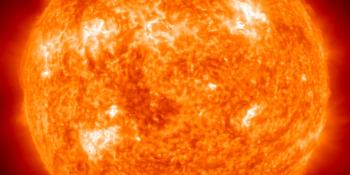
X1.5 solar flare
Últimos mensajes del foro
Apoye a SpaceWeatherLive.com!
A lot of people come to SpaceWeatherLive to follow the Solar activity or if there is a chance to see the aurora, but with more traffic comes higher costs to keep the servers online. If you like SpaceWeatherLive and want to support the project you can choose a subscription for an ad-free site or consider a donation. With your help we can keep SpaceWeatherLive online!



Hechos clima espacial
| Último evento clase X | 03/06/2026 | X1.0 |
| Último evento clase M | 21/06/2026 | M6.9 |
| Últimas tormentas geomagnéticas | 11/06/2026 | Kp5 (G1) |
| Días sin manchas | |
|---|---|
| Last 365 days | 3 días |
| 2026 | 3 días (2%) |
| Último día sin manchas | 24/02/2026 |
| Promedio de manchas solares mensuales | |
|---|---|
| mayo 2026 | 101.4 +22.1 |
| junio 2026 | 97.9 -3.5 |
| Last 30 days | 107.9 +10.3 |