Magnetisk klassificering av solfläckar
Sunspots come in all sizes and shapes. Some groups of sunspots have a more complex magnetic structure than other sunspot groups and are more likely to produce solar flares. But how do we know if a sunspot group is a threat for strong solar flares? To know the differences, the Mount Wilson observatory in California (USA) made rules so that every sunspot region receives a certain magnetic classification.
Every single day the sunspots on the Sun are counted and every sunspot group receives a number, a magnetic classification and spot classification by the space weather specialists. On our website you can find an overview of all the sunspot groups together with their classifications. Below you will get to know what all of those mean.
De olika klassificeringarna
- α – Alfa:
A unipolar sunspot group. - β – Beta:
A sunspot group that has a positive and a negative polarity (or bipolar) with a simple division between the polarities. - γ – Gamma:
A complex region in which the positive and negative polarities are so irregularly distributed that they can't be classified as a bipolar Sunspot group. - β-γ – Beta-Gamma:
A bipolar sunspot group but complex enough so that no line can be drawn between spots of opposite polarity. - δ – Delta:
The umbrae of opposite polarity in a single penumbra. - β-δ – Beta-Delta:
A sunspot group with a general beta magnetic configuration but contains one (or more) delta sunspots. - β-γ-δ – Beta-Gamma-Delta:
A sunspot group with a beta-gamma magnetic configuration but contains one (or more) delta sunspots. - γ-δ – Gamma-Delta
A sunspot group with a gamma magnetic configuration but contains one (or more) delta sunspots.
More than half of the observed sunspot groups receive an Alpha or Beta classification, where bigger sunspots are often more complex and get a Beta, Beta-Gamma or Beta-Gamma-Delta classification. It is well known that delta sunspots can be very active and produce the most intense solar flares.
The delta classification
Let's dig a bit deeper into the magnetic delta class. This is the most interesting type of sunspot structure due to the high solar activity which they often cause. With the following list you can determine whether a sunspot has a magnetic delta structure:
- Delta groups are often very big and 90 percent of the sunspots have a reversed polarity with a high activity level, especially when big solar flares erupt. These have mostly a complex, unusual or broken view of the umbra.
- Delta groups are formed by the aggregation of sunspots with opposite polarity of various dipoles, which are linked to shared magnetic field lines rather than direct magnetic lines. All spots are located in the penumbral region.
- Delta spots rarely last longer than one rotation of the Sun. They decay quicker then other sun spots. However, new delta spots can form within the same area.
- Delta sunspot groups usually do not separate, but rather die together.
- Active delta groups emit strong H-alpha emissions. Sometimes filaments can come out of the group.

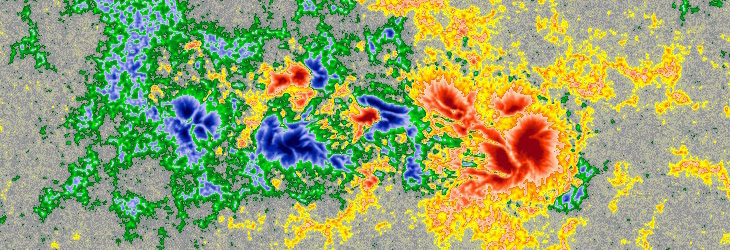
An example of a very complex sunspot group with a Beta-Gamma-Delta magnetic classification as seen by NASA SDO's HMI instrument. This sunspot region was the source of a major X2.3 solar flare. The top image shows us this sunspot region in visible light. The bottom image is a so called ''magnetogram'' and shows the magnetic layout of a sunspot region. The red color indicates sunspots or areas with a negative polarity and the blue color indicates areas with positive polarity sunspots.
<< Tillbaka till föregående sida
Senaste nytt
Coronal hole faces Earth
X1.5 solar flare
M2.7 solar flare, CME arrival possible
Senaste inläggen
Fler foruminläggStöd SpaceWeatherLive.com!
A lot of people come to SpaceWeatherLive to follow the Solar activity or if there is a chance to see the aurora, but with more traffic comes higher costs to keep the servers online. If you like SpaceWeatherLive and want to support the project you can choose a subscription for an ad-free site or consider a donation. With your help we can keep SpaceWeatherLive online!



Rymdvädersfakta
| Senaste X-utbrottet | 2026/04/24 | X2.5 |
| Senaste M-utbrottet | 2026/05/22 | M2.3 |
| Senaste geomagnetiska stormen | 2026/05/16 | Kp6- (G2) |
| Fläckfria dagar | |
|---|---|
| Last 365 days | 3 dagar |
| 2026 | 3 dagar (2%) |
| Senaste dag utan solfläckar | 2026/02/24 |
| Månadsvis faktiskt antal solfläckar | |
|---|---|
| april 2026 | 79.3 -6.6 |
| maj 2026 | 87.5 +8.2 |
| Last 30 days | 98 +7.5 |