Vad är en koronamassutkastning (KMU)?
A coronal mass ejection (or CME) is a giant cloud of solar plasma drenched with magnetic field lines that is blown away from the Sun often during strong, long-duration solar flares and filament eruptions. When the Sun isn't very active during solar minimum, coronal mass ejections are rare. There might only be one coronal mass ejection every week. When the Sun's activity increases towards solar maximum, coronal mass ejections become more common and we can see multiple coronal mass ejections every day.
The first proof of these dynamic events came from observations made with a coronagraph on the OSO 7 spacecraft between 1971 and 1973. A coronagraph produces a solar eclipse by covering the Sun with a small disk. Coronal mass ejections are very faint and can not be observed otherwise. The SOHO and STEREO missions have white-light coronagraphs onboard to detect coronal mass ejections. Coronal mass ejections are the prime source of strong geomagnetic storms and thus are very important to keep an eye on. The animation below shows a coronal mass ejection as seen by LASCO onboard the SOHO spacecraft.
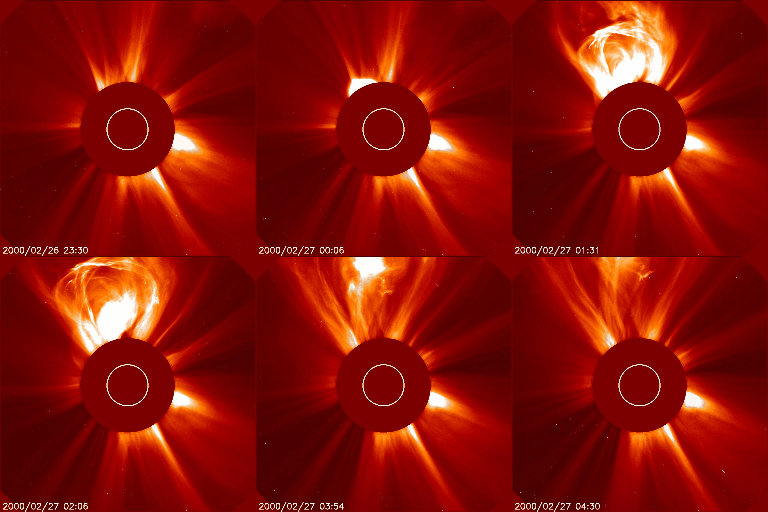
A coronal mass ejection can escape from the Sun during eruptions on the Sun like solar flares and filament eruptions. However, not every event has a coronal mass ejection accompanied with it. Strong flares (M and X-class) are likely candidates to launch coronal mass ejections but during rare occasions, even some B or C-class solar flares have launched coronal mass ejections but these are often only minor events. Another factor is the duration of the solar flare. For example, when there is a solar flare with a peak strength of X5 and with a total duration of two hours then it will certainly be accompanied with a bright, large and fast coronal mass ejection. Depending on the location of the eruption, the blast could either miss Earth, be partially or fully Earth-directed. An Earth-directed coronal mass ejection will look like a partial or full-halo coronal mass ejection on the images from SOHO. When this happens the coronal mass ejection will arrive at Earth after 24 hours or more (depending on the speed) and will likely cause a geomagnetic storm with vivid auroral displays.
<< Tillbaka till föregående sida
Senaste nytt
Coronal hole faces Earth
X1.5 solar flare
M2.7 solar flare, CME arrival possible
Senaste inläggen
Fler foruminläggStöd SpaceWeatherLive.com!
A lot of people come to SpaceWeatherLive to follow the Solar activity or if there is a chance to see the aurora, but with more traffic comes higher costs to keep the servers online. If you like SpaceWeatherLive and want to support the project you can choose a subscription for an ad-free site or consider a donation. With your help we can keep SpaceWeatherLive online!



Rymdvädersfakta
| Senaste X-utbrottet | 2026/04/24 | X2.5 |
| Senaste M-utbrottet | 2026/05/22 | M2.3 |
| Senaste geomagnetiska stormen | 2026/05/16 | Kp6- (G2) |
| Fläckfria dagar | |
|---|---|
| Last 365 days | 3 dagar |
| 2026 | 3 dagar (2%) |
| Senaste dag utan solfläckar | 2026/02/24 |
| Månadsvis faktiskt antal solfläckar | |
|---|---|
| april 2026 | 79.3 -6.6 |
| maj 2026 | 87.5 +8.2 |
| Last 30 days | 98 +7.5 |